
On this page
You know you want to run a survey. You just don't know what to ask about. Maybe it's a class project due Friday, a team that feels a bit flat, or a customer list you've never asked anything. A blank page doesn't help.
This guide gives you 60 survey ideas, sorted by who you're asking: customers, your team, students, event guests, your community, and friends who just want a laugh. Each idea comes with a sample question and the question type that fits it. You'll also see how to pick a topic worth asking about, which ideas make poor surveys, and how to run your first one this week. The full list is a free spreadsheet you can filter by audience.
How to pick a survey topic#
Pew Research Center lists the first step of questionnaire design plainly: "The first is identifying what topics will be covered in the survey" (Pew Research Center, writing survey questions, accessed 28 October 2026). Good survey ideas pass three quick tests:
- It feeds a decision. Finish this sentence: "We'll use the answers to decide ___." If you can't fill the blank, the topic is trivia.
- The right people can answer it. Ask customers about your checkout, not about your hiring plans. Ask students about homework, not about the school budget.
- You can act on the answer. If nothing changes whatever people say, don't waste their time.
One survey, one topic. A short survey about one thing is easier to finish, and easier to act on. Once you have the topic, our guide on how to write survey questions helps you word each question so people can answer it quickly and honestly. For ready-made questions by audience, see our feedback form questions.
60 survey ideas by audience#
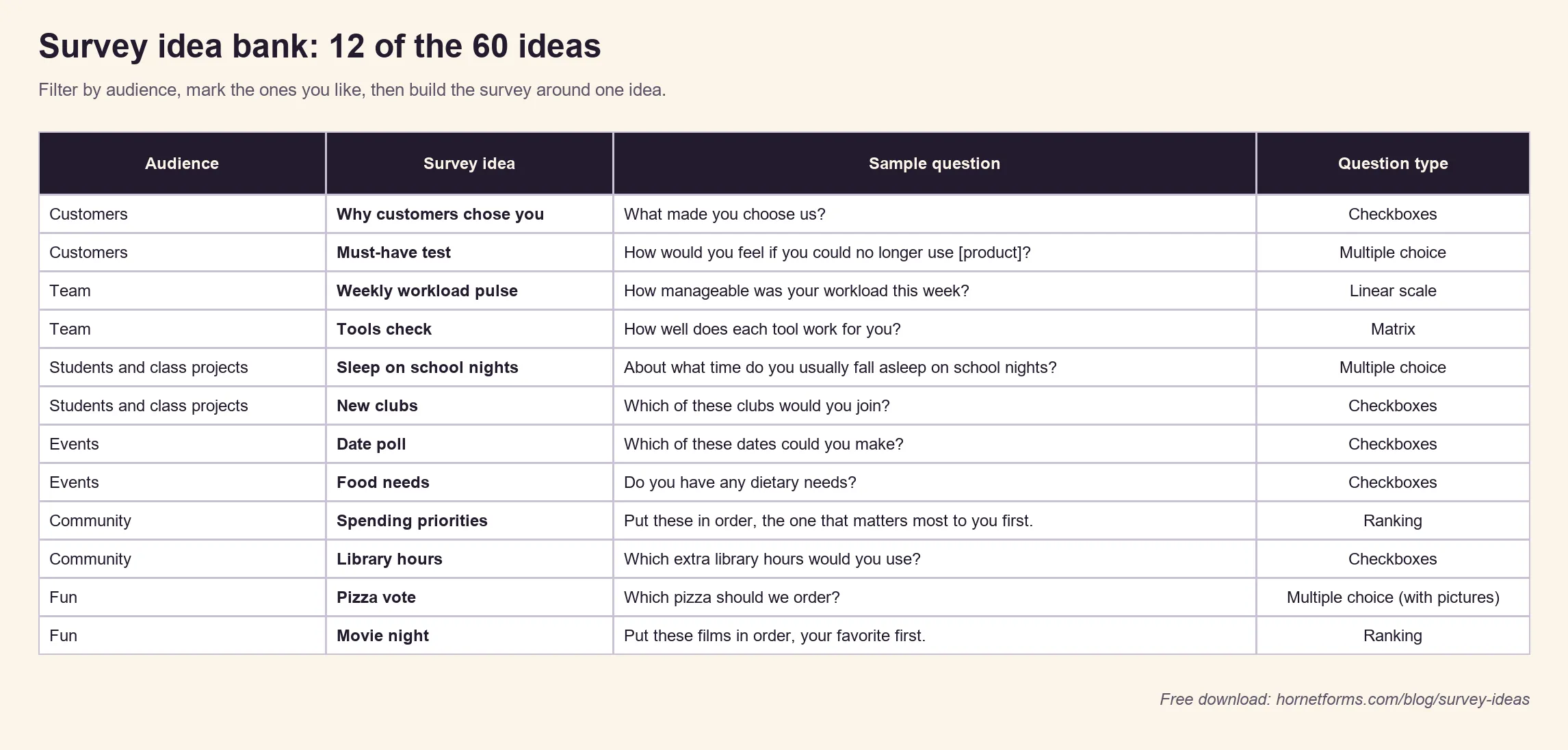
Here are the survey ideas, 10 per audience. They work just as well as questionnaire ideas for a paper handout. Each line gives the idea and a sample question you can copy. The idea bank at the end adds the question type, answer options and what each one helps you decide.
Customers#
- Satisfaction after a purchase: "How satisfied are you with your order?"
- Would you recommend us? "How likely are you to recommend us to a friend or colleague?" (0 to 10)
- Why customers chose you: "What made you choose us?"
- How people found you: "How did you first hear about us?"
- Why people cancel: "What is the main reason you are cancelling?"
- Feature wish list: "Put these ideas in order, the one you want most first."
- Website visit check: "Did you find what you were looking for today?"
- First week as a customer: "How easy was it to get started in your first week?"
- Must-have test: "How would you feel if you could no longer use [product]?"
- Price check: "How would you describe our prices for what you get?"
Several of these already exist as ready-made forms. Start from the customer satisfaction survey template, the website feedback survey, the cancellation survey template, the customer onboarding survey or the product market fit survey template. For the 0 to 10 question, our guide on how to calculate NPS shows the math. Researching a new product or market? Start with these market research survey questions.
Team#
- Weekly workload pulse: "How manageable was your workload this week?"
- Meetings worth keeping: "Which of our regular meetings could we cut or shorten?"
- Training wish list: "Put these skills in order, the one you want training in most first."
- Tools check: "How well does each tool work for you?"
- Team day date poll: "Which of these dates could you make?"
- Office days: "How many days a week would you like to work in the office?"
- New hire 30-day check-in: "What would have made your first month easier?"
- Team news: "Where do you look first for team news?"
- Biggest time sink: "What is one thing that slows you down every week?"
- Shout-outs: "Who went out of their way to help you this month, and how?"
Tell people up front who will read their answers, and make sure it's true. In HornetForms, everyone you add to your workspace, whatever their role, can read every response in it. Name those people in the form's introduction.
Students and class projects#
- Homework time: "On a typical school night, how long do you spend on homework?"
- Sleep on school nights: "About what time do you usually fall asleep on school nights?"
- Cafeteria food: "How would you rate the cafeteria food this term?"
- Getting to school: "How do you usually get to school or campus?"
- Phone and app habits: "Which kinds of apps do you open most days?"
- Course feedback: "How clear were the instructions for the assignments?"
- New clubs: "Which of these clubs would you join?"
- Part-time work: "How many hours a week do you work for pay during term?"
- Exam week stress: "How stressed do you feel during exam weeks?"
- Reading for fun: "How many books did you read for fun in the last 12 months?"
Teachers can run idea 6 as a full course evaluation form. Asking families instead? See our parent survey questions. Students: check with your instructor before you send a survey for a class project, especially if you plan to share results outside class. Universities set their own rules here. Northeastern University's classroom research policy, for example, covers survey questions a student asks "as part of a course which is designed to develop or contribute to student learning or class discussion", and says "Faculty will be responsible for ensuring that all student research projects are conducted in accordance with federal regulations" (Northeastern University, Policy on Classroom Research Involving Human Subjects, accessed 28 October 2026).
Events#
- After-event score: "How likely are you to recommend this event to a friend or colleague?"
- Session ratings: "How would you rate each session?"
- Date poll: "Which of these dates could you make?"
- Topic picks: "Put these topics in order, the one you most want to hear about first."
- Food needs: "Do you have any dietary needs?"
- Travel distance: "How far would you travel for an event like this?"
- Ticket price: "What would you expect to pay for a one-day ticket?"
- Workshop takeaway: "What is the first thing from today's workshop you will try?"
- Speaker feedback: "How useful was this talk for you?"
- Volunteer debrief: "What should we change for volunteers next time?"
Ideas 3 to 7 work before the event, the rest after it. For a full after-event survey, use the event feedback form template or pick from our post-event survey questions.
Community#
- Spending priorities: "Put these in order, the one that matters most to you first."
- Park use: "How often do you visit [park name]?"
- Library hours: "Which extra library hours would you use?"
- Classes at the community center: "Which of these classes would you sign up for?"
- Farmers market: "What would bring you to the farmers market more often?"
- Newsletter check: "Which parts of the newsletter do you read?"
- First visit welcome: "How welcome did you feel at your first meeting?"
- Volunteer time: "How many hours a month could you volunteer?"
- Street safety: "Which street or crossing feels least safe to you, and why?"
- How to reach people: "How would you like to hear about local events?"
Asking for comments on one specific plan, like a new bike lane? That's a different job. Our public comment form guide covers it.
Fun#
- Pizza vote: "Which pizza should we order?" (with a picture on each option)
- Team name: "Which name should we pick?"
- Shared playlist: "Which one song should we add to the playlist?"
- Movie night: "Put these films in order, your favorite first."
- Party theme: "Which party theme sounds most fun?"
- Coffee or tea: "Coffee or tea?"
- Desert island book: "Which one book would you take to a desert island?"
- Pet photo contest: "Upload a photo of your pet."
- Superpower: "Which superpower would you pick?"
- Bake-off judging: "How would you rate [entry]?"
Fun survey ideas are a good warm-up. A two-question pizza vote teaches you how to build, share and read a survey before the stakes are real. And nobody argues with the pizza results. Much.
Match the idea to a question type#
Survey ideas tell you what to ask. The question type decides what kind of answer you get back. Pew notes that researchers "will sometimes conduct a pilot study using open-ended questions to discover which answers are most common." That's a good habit for any new topic: ask it open first, then turn the common answers into options.
| If you want to... | Use | Example from the list |
|---|---|---|
| Get one number you can track | Rating or Linear scale | Weekly workload pulse, cafeteria food |
| Count which option wins | Multiple choice | Coffee or tea, how people found you |
| Let people pick several | Checkboxes | Date poll, food needs, library hours |
| Learn what matters most | Ranking | Spending priorities, feature wish list |
| Rate several things on one scale | Matrix | Session ratings, tools check |
| Hear ideas you didn't think of | Short or Long answer | Biggest time sink, volunteer debrief |
| Collect a file | File upload | Pet photo contest |
HornetForms has 20+ question types, including ranking, matrix and file upload, and choice options can show a picture. Our guide to every question type, and when to reach for it goes through them one by one. For agree and disagree scales, the Likert scale survey post shows how to label and score them.
Ideas that make poor surveys#
Not every question needs a survey. Some survey ideas sound fine but fall apart once the answers arrive. Skip these:
- Things you can already see. Page visits, sales by month, who came to the event. Check your own records first.
- A choice for three people. If three people decide, ask them in a message.
- Decisions you have already made. People notice when nobody reads their answers, and they stop answering next time.
- Questions people can't really answer. "Would you buy this if we built it?" asks people to predict the future. Ask about what they do today instead.
- Reports about misconduct or safety. Those need a proper reporting process, not a survey.
- Very personal topics in a class project. Health, money troubles and family matters need your instructor's sign-off, if they belong in the project at all.
Get the survey ideas bank#
The free survey idea bank (Excel) has all 60 survey ideas in one sheet. Each row has:
- The audience and the idea
- What it helps you decide
- A sample question
- A question type, named the way HornetForms names it
- Answer options you can copy, with [square brackets] where your own words go
Filter the Audience column to see one group at a time. Mark your favorites with Yes in the "Pick it?" column, then filter to those. The Read me tab counts the ideas you picked for each audience. Prefer plain text? There's a CSV copy too.
Once you've picked an idea, you'll need three to eight more questions on the same topic. Borrow them from the free survey question bank in our guide on how to write survey questions, or from the ready-made set in our questionnaire guide. Recruiting people for user research? Start with screener survey questions.
Run the first one#
Pick one idea from the list and build it today. Not sure which tool to use? Here's how to pick a free survey maker.
- Build it. Create a form in HornetForms, add your sample question and a few follow-ups, and keep it short.
- Test it on five people. Watch where they pause and fix those questions.
- Share it where your people are. Send the link by email or chat, or download a QR code (PNG or SVG) for a poster, a class handout or the event check-in desk.
- Watch the answers come in. You can turn on an email to yourself for each new response.
- Read the results. The Summary tab shows the results question by question, and a CSV export takes the raw answers to a spreadsheet.
The Free plan is free forever, with unlimited responses within fair use, so a survey that takes off keeps collecting. Our post on when your form hits the response limit explains why that matters. The features page lists the rest. Sign up for free and send your first survey this week.