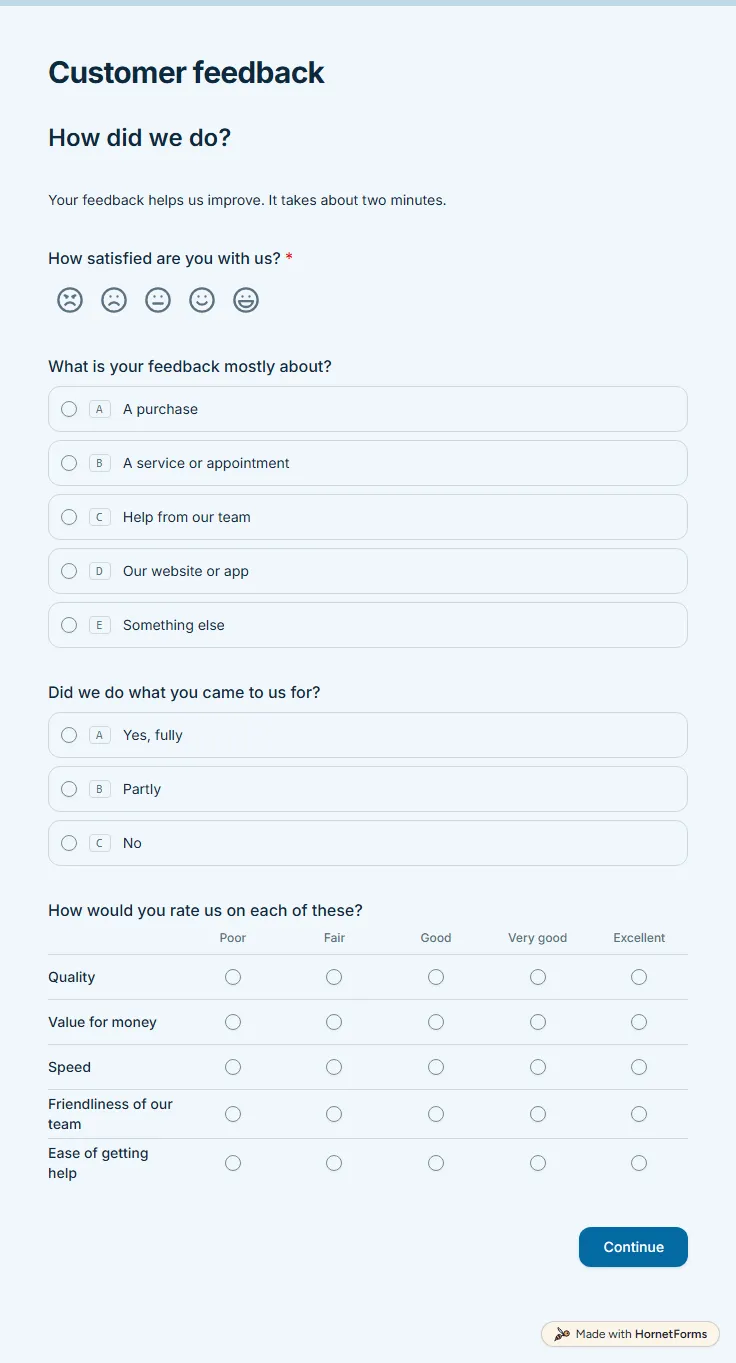
Customer satisfaction survey template (free)
A free customer satisfaction survey with a five-face CSAT question, a quality grid and a 0 to 10 recommend score. Low scores get a follow-up box.
11 questions on 2 pages
Launch week: 50% off Pro and Business with code LAUNCH50, while spots last. See pricing
A product market fit survey template asks the people who use your product one blunt question: how would you feel if you could no longer use it? They pick very disappointed, somewhat disappointed or not disappointed, and that answer steers the rest. The very disappointed group sees two follow-ups about the main benefit they get and the type of person who would benefit most. People who would not be disappointed get asked what it would take to make the product genuinely useful. Everyone can then say what they would use instead, how to improve it, how often they use it, their role and how they first found you. It is one page with nine questions and only the first is required. Sign up for free, open the template and send it to people who have used your product recently.
Free plan, free forever. Sign up and the template opens in your workspace.
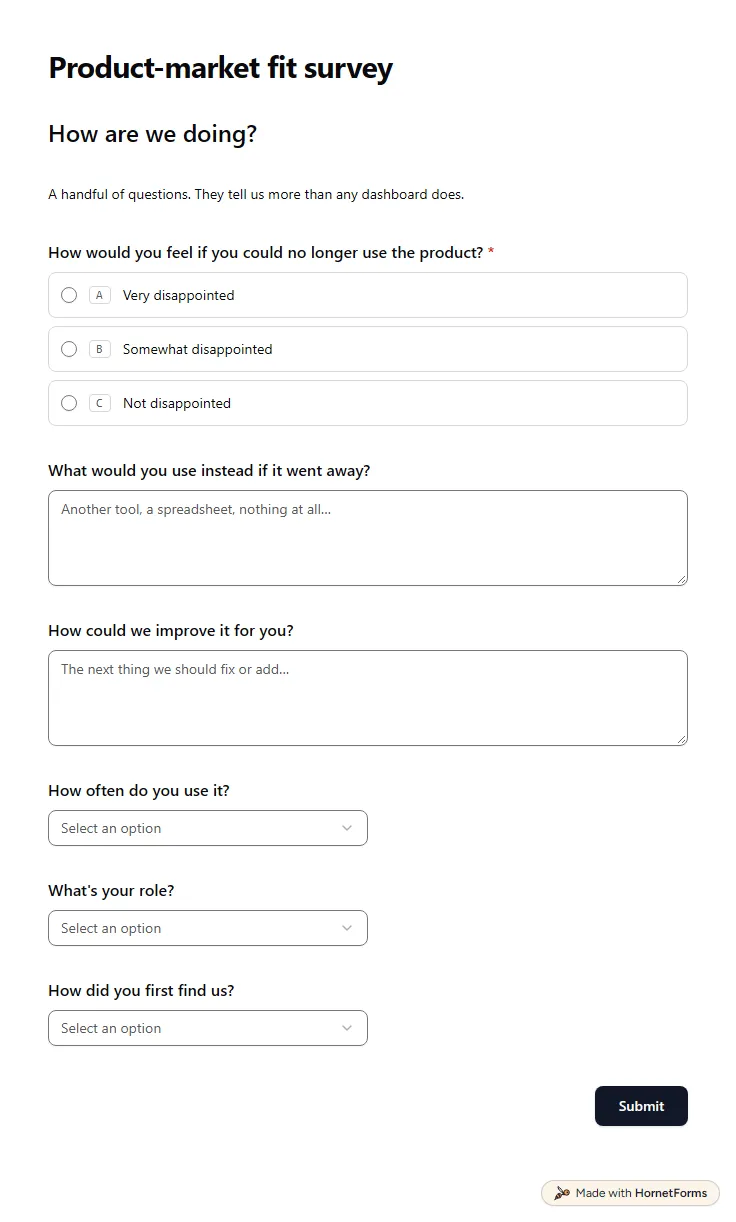
9 questions on one page. Every question, in order:
| No. | Question | Answer type | Required? |
|---|---|---|---|
| 1 | How would you feel if you could no longer use the product?Multiple choice, RequiredChoices: Very disappointed, Somewhat disappointed, Not disappointed | Multiple choice | Required |
| 2 | What's the main benefit you get from it?Long answer, Optional | Long answer | Optional |
| 3 | What type of person would benefit most from it?Long answer, Optional | Long answer | Optional |
| 4 | What would it take to make it genuinely useful to you?Long answer, Optional | Long answer | Optional |
| 5 | What would you use instead if it went away?Long answer, Optional | Long answer | Optional |
| 6 | How could we improve it for you?Long answer, Optional | Long answer | Optional |
| 7 | How often do you use it?Dropdown, OptionalChoices: Every day, A few times a week, A few times a month, Rarely | Dropdown | Optional |
| 8 | What's your role?Dropdown, OptionalChoices: Founder, Engineering, Product, Design, Marketing, Sales, Operations, Something else | Dropdown | Optional |
| 9 | How did you first find us?Dropdown, OptionalChoices: A friend or colleague, Search engine, Social media, A newsletter or blog, An ad, I can't remember | Dropdown | Optional |
Thanks for your answers!
This is the survey we read most closely. It shapes what we build next.
The same questions, ready to print or edit.
Every response lands in your HornetForms inbox. From there, send it wherever your team already works.
It is the question at the top of this template: how would you feel if you could no longer use the product, with three answers from very disappointed to not disappointed. Ellis set his benchmark after comparing results across nearly 100 startups, so it is a rule of thumb from practice rather than a formal study.
The core question, then follow-ups that explain it: the main benefit, who would benefit most, what they would use instead and how to improve it. Usage, role and how they found you let you split the results. Logic shows each follow-up only to the people it fits.
Divide the number of very disappointed answers by everyone who answered the first question, then multiply by 100. For example, 48 very disappointed answers out of 120 gives 40%. Run the same sum for each role or usage group to see where the product lands hardest.
PMF stands for product market fit: the point where a product meets a real need for a clear group of people. A PMF survey asks your users how much they depend on the product, so you can measure that instead of guessing from sign-up numbers.
A free customer satisfaction survey with a five-face CSAT question, a quality grid and a 0 to 10 recommend score. Low scores get a follow-up box.
11 questions on 2 pages
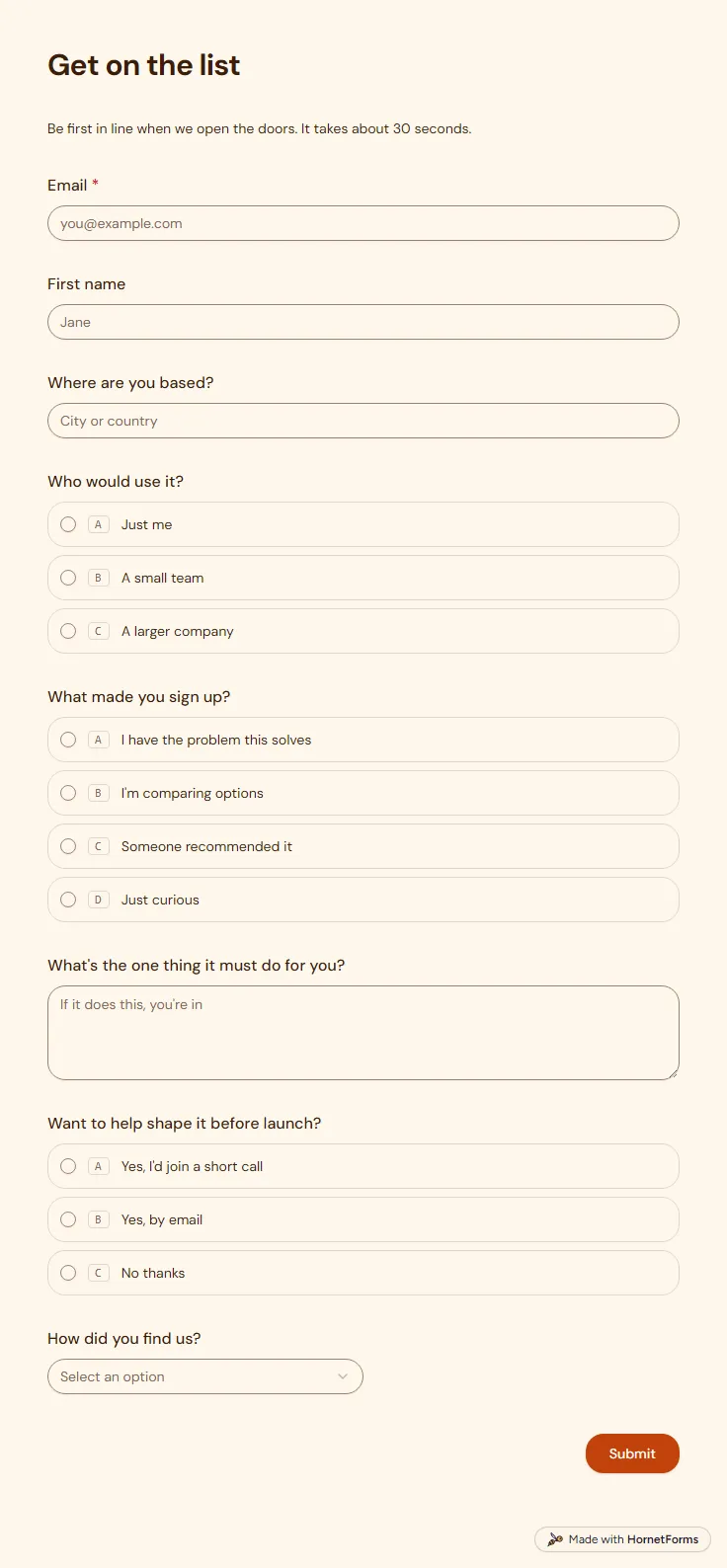
A free waitlist form that records which link sent each sign-up and asks what people need, so your list is useful on launch day.
8 questions on one page
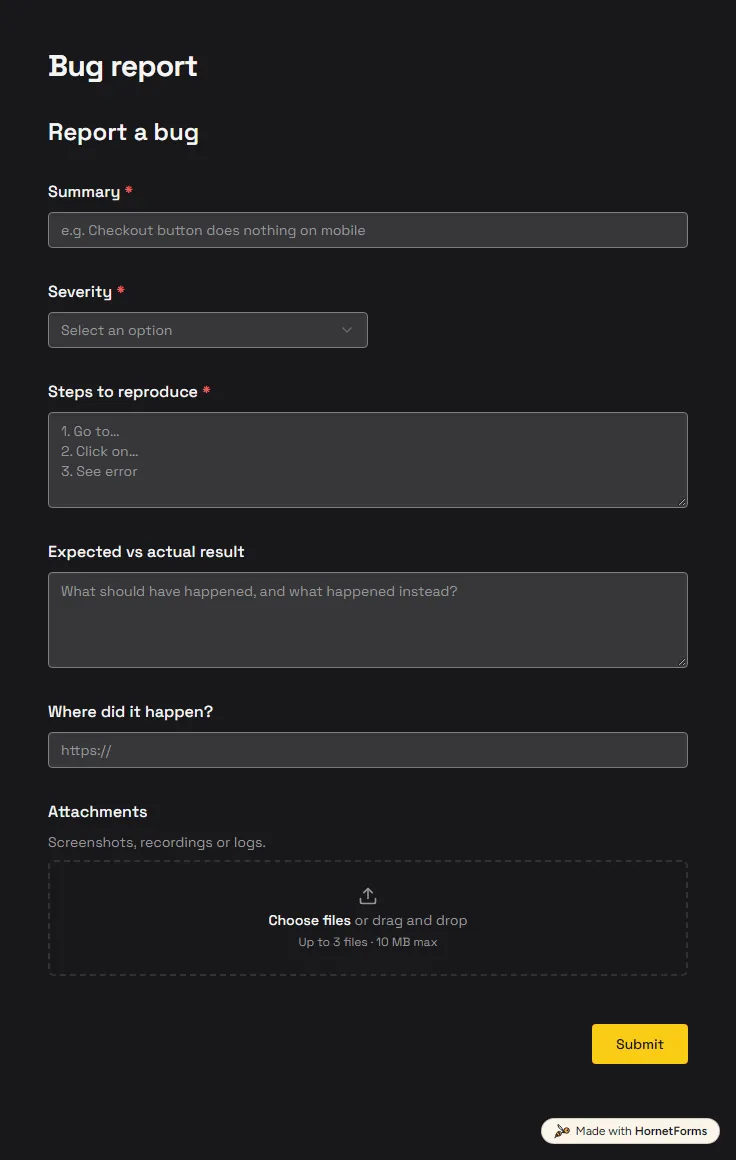
A free bug report form that asks for severity, steps and screenshots, and records the app version and browser from the link.
6 questions on one page
Run a product market fit survey the Sean Ellis way: who to ask, the questions, how to score the 40% test, and a free calculator for your answers.
A free feature request form template that asks for the problem, stamps each request with who asked, and sorts the pile in a free triage sheet.
Sign up for free, pick a template and change anything you like: questions, logic and design. The Free plan stays free forever, with unlimited responses.