
On this page
Your teacher, your boss or a grant form asks for "a survey". You write a list of questions and wonder: is this a survey, or is it a questionnaire? People use the two words as if they mean the same thing. Most of the time nobody minds. But in a research write-up, a grant report or a class project, the difference between survey and questionnaire matters. Get it right and you sound like you know what you did.
This guide explains survey vs questionnaire in plain words. You'll get a one-line answer, a side-by-side table, where polls and interviews fit, examples you can reuse in a report and a free one-page cheat sheet.
The short answer: the difference between survey and questionnaire#
A questionnaire is the list of questions. A survey is the whole study: who you ask, how you ask, the questionnaire itself and what you do with the answers.
So the difference between survey and questionnaire is one of size. A questionnaire is a tool. A survey is a process that uses that tool. Every survey needs a questionnaire (or an interview script), but plenty of questionnaires never become part of a survey.
The US research group Pew Research Center puts it in a single line in its guide to survey questions: "Creating good measures involves both writing good questions and organizing them to form the questionnaire" (Pew Research Center, Writing survey questions, accessed 28 October 2026). In other words, the questionnaire is one part of the survey process. Pew calls the creation of questions "perhaps the most important part of the survey process", which tells you the survey is bigger than its questions.
What a questionnaire is#
A questionnaire is a set of questions in a set order, with any instructions people need to answer them. It can sit on paper, in a Word file or in an online form. It can have three questions or 60.
What makes it a questionnaire is the format, not what you do with the answers. A questionnaire works fine for one person at a time:
- A health history questionnaire a new patient fills in at the front desk
- A client intake questionnaire a designer sends before a first call
- A job application questionnaire with a few screening questions
- A student information sheet that a parent fills in at the start of the year
None of these are surveys. Nobody adds up the answers to learn about a group. Each one collects facts about a single person so you can act on them.
Order and grouping make a questionnaire easier to answer. Pew's advice: "A questionnaire, like a conversation, should be grouped by topic and unfold in a logical order." It also warns that "questions asked earlier in a survey may influence how people respond to later questions". That's why you usually see broad questions first and personal details (age, income) at the end. Layout counts too: a title, a short introduction, sections and a thank-you line tell people what to expect. Our guide to questionnaire format covers each part.
If you want a ready-made one to start from, our questionnaire template gives you 12 feedback questions in Word, PDF and an online version.
What a survey is#
A survey is a study that collects answers from a group of people and analyses them to learn something about that group. The American Association for Public Opinion Research (AAPOR), the US professional body for survey researchers, defines it in its code of ethics:
"Public opinion, survey research, and surveying" refers to the systematic collection and analysis of information from or about individuals, groups, or organizations concerning their behaviors, cognitions, attitudes, or other characteristics.
That comes from AAPOR, The Code of Professional Ethics and Practices (as amended June 2026, accessed 28 October 2026). Notice the two key words: collection and analysis. A survey doesn't end when the answers come in. It ends when you've worked out what they mean.
A survey usually has these parts:
- A goal. What you want to learn, and what you'll decide with it.
- The people. Who you'll ask, and how you'll pick them. Pew notes that "Accurate random sampling will be wasted if the information gathered is built on a shaky foundation of ambiguous or biased questions." Sampling and questions both count.
- The questionnaire. The questions people answer.
- The mode. Paper, online, phone or face to face.
- The analysis. Counts, percentages, averages and the patterns behind them.
- The report. What you found and what you'll do next.
Here's a survey example. A school sends the same 12-question course feedback form to all 80 students in a course, then reports how many replied and what share rated the course 4 or 5 out of 5. The form is the questionnaire. Sending it, counting the replies and writing up the results is the survey. That one example shows the difference between survey and questionnaire better than any definition.
Survey vs questionnaire, side by side#
Here's survey vs questionnaire in one table:
| Compare | Questionnaire | Survey |
|---|---|---|
| What it is | A set of questions in a set order, with instructions | A study that collects answers from a group and analyses them |
| Scope | One tool | The whole process: plan, who to ask, questions, collection, analysis |
| Who answers | One person or many | A group, often chosen to stand for a larger group |
| What you get | Each person's answers | Counts, percentages and patterns across the group |
| Can it stand alone? | Yes: an intake form or a health history questionnaire | No: every survey needs a questionnaire or an interview script |
| Example | A 12-question course feedback form | Sending that form to all 80 students and reporting what they said |
One quick test helps. Ask yourself, "Will I add up the answers?" If yes, you're running a survey, and the questions you send are its questionnaire. If no, and you'll read each set of answers on its own, you have a questionnaire.
That's also why phrases like "survey questionnaire" and "surveys and questionnaires" make sense. A survey questionnaire is simply the questionnaire a survey uses.
Is a poll a survey?#
In everyday speech, a poll is one or two quick questions to see where people stand. A show of hands in a meeting. A "Which day works best?" message in a team chat. A single question on a website. In that sense, poll vs survey is short vs long: a poll takes a pulse, a survey digs into the reasons.
Survey researchers don't draw a hard line, though. AAPOR's code groups the words together: "'Poll,' 'polling,' 'survey,' and 'surveying' and other similar terms imply that the primary source of data are from human respondents." News outlets often say "poll" for a full survey of public opinion with dozens of questions.
AAPOR does draw a line around one thing that calls itself a poll. Its statement on "push polls" says they "are not surveys at all, but rather unethical political telemarketing", calls meant to persuade rather than measure. One sign of a real survey, it says, is that "the interview contains more than a few questions" (AAPOR, Statements on "push" polls, accessed 28 October 2026).
So, survey or questionnaire or poll? Use "poll" for a quick pulse check, "survey" for a planned study and "questionnaire" for the questions themselves.
Questionnaire vs interview#
A questionnaire is something people fill in themselves. An interview is a conversation: one person asks the questions out loud and notes the answers.
Both can feed a survey. A phone survey uses an interview script. An online survey uses a questionnaire people read and answer on their own. AAPOR's guide for journalists points out that "there are different modes (phone, text, web, in-person) to conduct surveys, which can result in different results, known as 'mode effects'" (AAPOR, Journalist cheat sheet to understanding polls and surveys, accessed 28 October 2026).
How to choose:
- Pick a questionnaire when you need many answers, people can read and answer on their own, and you want the same questions asked the same way every time.
- Pick an interview when you need depth, people may struggle to read or write their answers, or you want to follow up on what they say.
- Mix them when it helps. Many teams send a short questionnaire to everyone, then interview five or six people whose answers stood out.
When the difference between survey and questionnaire matters#
Most days, nobody will correct you. But the difference between survey and questionnaire matters in three places.
Research write-ups and class projects. Your methods section should say what you did (the survey) and what you used (the questionnaire). Pew follows this split itself: "All of our survey reports include a topline questionnaire that provides the exact question wording and sequencing." The report is the survey; the attached questions are the questionnaire.
Lines you can reuse:
- "We surveyed all 80 students at the end of the spring term."
- "The survey used a 12-question questionnaire with rating scales and two open questions."
- "Of the 80 students invited, 52 completed the questionnaire. The full questionnaire is in Appendix A."
Grant reports and funder updates. Funders want to know how many people you asked, how many answered and what you learned. That's survey language. Attach the questionnaire so they can see the exact wording. Our questionnaire examples show what a finished one looks like.
Briefs and requests. If a manager asks you to "do a survey", ask what decision it should support and who should answer. If they just need a form for each new client, they need a questionnaire, and that's a smaller job. Either way, building a questionnaire starts in the same place: the decision the answers should support.
When you write the questions, the wording matters more than the label. Our guide on how to write survey questions covers the mistakes that bend answers. If your questionnaire uses agree or disagree scales, see the Likert scale survey guide for labels and scoring. Want a ready-made set to adapt? The questionnaire template has 12 questions in four sections.
Free survey vs questionnaire cheat sheet#
Keep the difference between survey and questionnaire on one page. The free cheat sheet has the short answer, the side-by-side table, a "which word to use" list for questionnaire, survey, poll and interview, and three report lines you can copy.
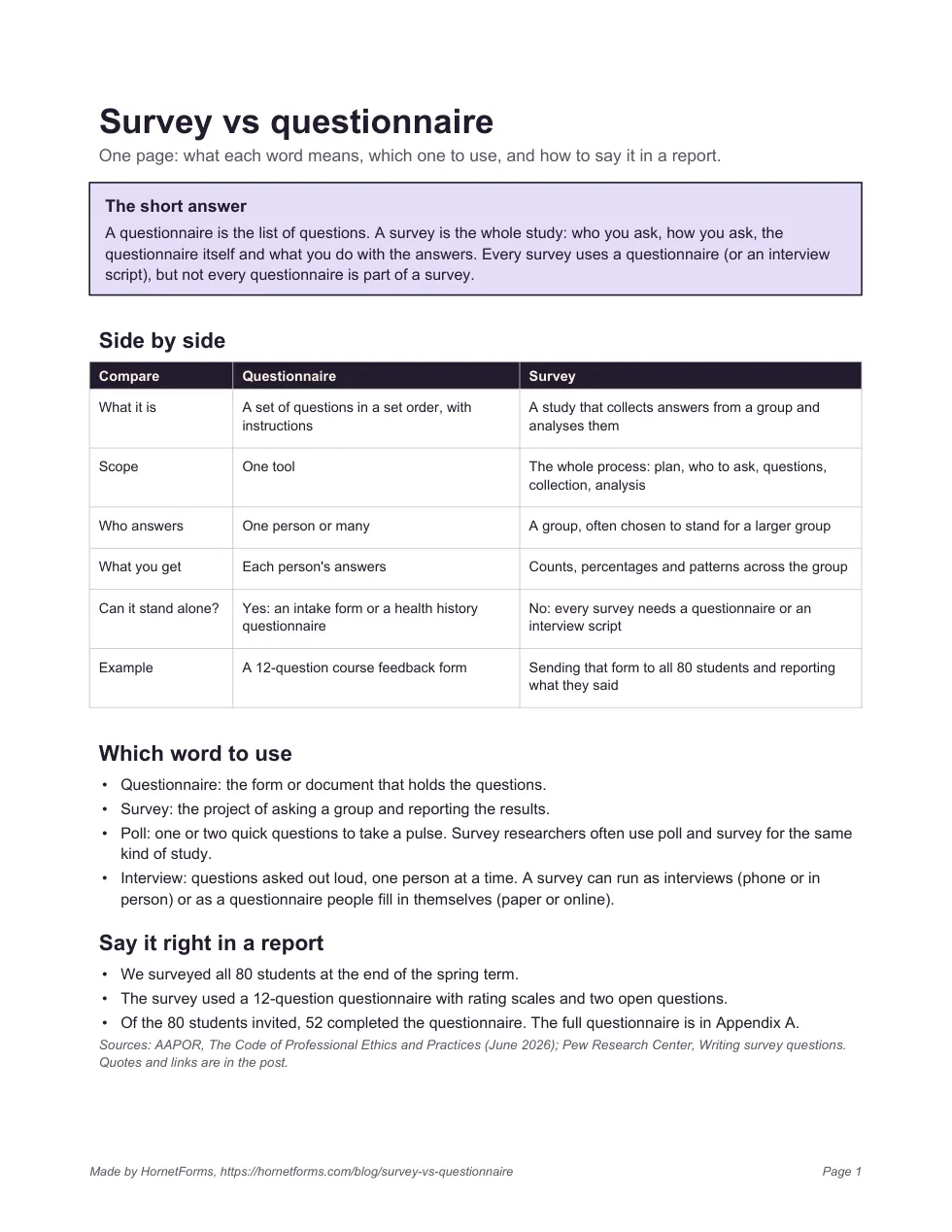
Download it:
Print it for a class, pin it above your desk or drop it into a project folder for the next person who asks.
Build either one online#
Once you know the difference between survey and questionnaire, the build looks the same for both. Whether you need one questionnaire for each new client or a survey of 500 customers, you write the questions, pick the right answer types and share a link. Still looking for a topic? Our list of survey ideas has plenty to start from.
In HornetForms you can:
- Build the questionnaire with 20+ question types, from multiple choice and rating scales to matrix grids and file upload. Our guide to every question type and when to use it helps you pick.
- Split long questionnaires over several pages with a progress bar, so people know how far they've got.
- Run the survey on a link or a QR code, with unlimited responses within fair use. That matters if you've ever hit a response limit halfway through a survey.
- Read the results in the Summary tab, which sums up each question in one place, or export a CSV on every plan.
- Follow along by turning on an email to yourself for each new response.
It's free forever on the Free plan. See what else it does on the features page, or sign up for free and build your first questionnaire today.