
On this page
Your foundation, PTA or Rotary club has money to give. Now you need a form that tells you who should get it. Ask too little and every application reads the same. Ask too much and the small groups you most want to reach give up on page three.
This guide is for the people writing the grant application questions, not answering them. You'll get the core question set, a short version for mini-grants, the files worth asking for and a scoring rubric with plain 0 to 4 anchors. At the end there's a free application template and a rubric spreadsheet that totals each reviewer's scores and flags where your reviewers disagree.
Who these grant application questions are for#
Small funders who run their own round, usually once or twice a year:
- Community foundations with a few local funds and a volunteer grants committee.
- PTAs and school foundations that hand out classroom or club grants.
- Service clubs like Rotary, Lions or a local women's club giving back to the town.
- Cities and counties running neighbourhood or youth mini-grants.
The applicants are organisations asking for money: a food pantry, a youth soccer league, a group of neighbours with a garden plan. That makes this a different form from a board seat application, where a person asks to serve. If that's what you're filling, see our guides to the board and commission application and the nonprofit board member application. Funding students instead? See the scholarship application form guide.
The core grant application questions#
Funders ask much the same things, and every extra question costs the applicant time. The Trust-Based Philanthropy Project, a funder-to-funder initiative, puts it plainly: "Nonprofits spend an inordinate amount of time on funder-driven applications and reports, which can distract them from their mission-critical work" (Trust-Based Philanthropy Project, practices for trust-based philanthropy, accessed 28 October 2026). So keep your grant application questions to the ones you'll actually score.
These common grant application questions fall into six areas. Each area maps to a line on your rubric, so every answer gets read and scored.
| Area | Questions to ask | What it tells you |
|---|---|---|
| Organisation | Name, contact, type of group, fiscal sponsor if any, mission in two sentences, last year's budget | Who you're dealing with, and whether they can take the money |
| Need | Who will this serve, and about how many? How do you know the need is real? | Whether the problem exists, in their own community |
| Plan | What are the main steps, who does each one, and when? What could get in the way? | Whether they can actually do it in your grant period |
| Outcomes | What will be different when it ends? How will you know? | What you'll be able to report back to your donors |
| Budget | What does each item cost? What does our grant pay for, and what do other sources cover? | Whether the costs make sense for the plan |
| After the grant | How will this keep going when the money is spent? If it's a one-off, what will it leave behind? | Whether your money starts something or just fills a gap |
Organisation questions#
Keep these short. Ask the type of group as a multiple choice: registered nonprofit, school or PTA, or community group with or without a fiscal sponsor. Then say plainly whether you can fund groups with no legal status.
Need, plan and outcomes questions#
These are the long answers, and the grant application questions your reviewers will argue about. Ask for evidence in words people can manage: "local numbers, a waiting list, a survey or what people have told you". A soccer league doesn't have a needs study. It does have 40 kids on a waiting list. To gather that kind of evidence for your own fund, run a community needs assessment survey before the round opens.
For the plan, a small table (step, who, when) beats an essay. For outcomes, ask two separate questions: what will change, and how they'll know. Groups often answer the first well and skip the second.
Budget and sustainability questions#
Ask for every cost, with a column for what your grant pays and one for other money or in-kind help. That table shows whether the request fits the plan. Then ask what happens after. A one-off event is fine, as long as the applicant says so.
Questions for mini-grants#
A mini-grant of a few hundred dollars doesn't deserve a nine-part form. If the application takes longer to write than the money takes to spend, the best small groups won't bother. Our guide on how to make an application form people finish has more on cutting questions. Use a one-page version instead:
- Your name, group and role
- Email and phone
- Project name, and the amount you're asking for
- What will you do, for whom, and when?
- Why does it matter to the people it serves?
- How will you spend the money? List the main costs.
- How will you know it worked?
Seven sample grant application questions, one signature, done. Score them on the same rubric with fewer criteria switched on: need, plan and budget usually do the job. Our printable template includes this one-page mini-grant application next to the full version.
Attachments to ask for#
Ask for files only when a reviewer will open them. For most small grants that means:
- A detailed budget, if it won't fit in the form's table. Required.
- Proof of status, such as a nonprofit determination letter, or a letter from the fiscal sponsor.
- Quotes for any single item over a set amount, say $500.
- Up to two letters of support from partners or the people the project serves. Optional.
- The latest annual report or a list of board members. Optional, and often skippable for mini-grants.
Mark each one required or optional, so nobody spends a weekend chasing a letter you'll never read.
A grant scoring rubric with anchors#
A rubric turns "I liked this one" into a number your committee can compare. It has three parts: the criteria (the six areas above), a weight for each and a description of what each score means. Those descriptions are the anchors. Without them, one reviewer's 3 is another reviewer's 4.
Public funders publish theirs. The City of Salem, New Jersey, scores its youth mini-grant out of 100 points across six areas. Its top budget band reads "Budget is detailed, reasonable, and clearly connected to program activities", and its bottom band reads "Budget is incomplete or unreasonable" (City of Salem, Application Scoring Rubric, accessed 28 October 2026). The California Governor's Office of Emergency Services defines its lowest score as "Does not address any required elements" (Cal OES, 2020 HSGP Tribal Scoring Rubric, accessed 28 October 2026). The Kentucky Arts Council says of its arts grant that "Each performance expectation is worth up to ten points" (Kentucky Arts Council, Teaching Art Together Grant Scoring Rubric, accessed 28 October 2026).
Wide bands suit big panels. A volunteer committee agrees faster on 0 to 4. Here are the anchors from our free grant scoring rubric template:
| Score | Meaning | Example for "Need" |
|---|---|---|
| 0 Not shown | The part is missing | No need is described |
| 1 Weak | Stated, but not explained | The need is stated but not explained |
| 2 Fair | Described, with gaps or little evidence | The need is described, with little evidence |
| 3 Good | Clear and realistic, with some evidence | A clear need, with some local evidence such as numbers, a waiting list or quotes |
| 4 Strong | Clear, specific and backed by evidence | A clear, specific need, backed by local evidence and the words of the people affected |
The default weights are need 25%, plan 20%, outcomes 20%, budget 15%, capacity 10% and sustainability 10%. Change them to fit your fund.
The spreadsheet turns each reviewer's 0 to 4 scores into a weighted score out of 100: the sum of score times weight, divided by 4 times the sum of the weights, times 100. A reviewer who gives 3 on every criterion lands on 75.
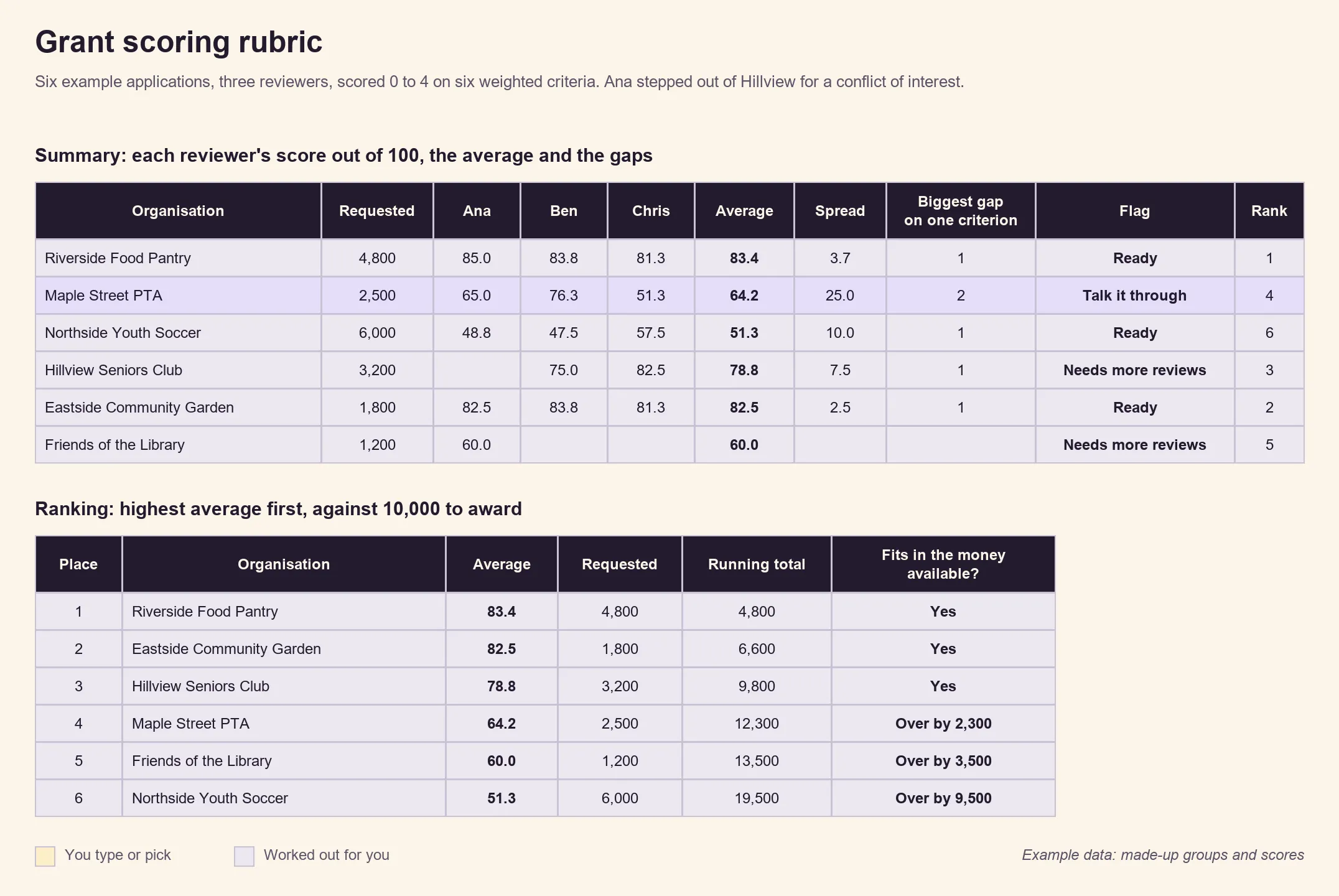
EXAMPLE data: we made up the groups, reviewers and scores. Delete them and add your own.
Reviewers: conflicts and consistency#
Small funders live in small towns. Your reviewer coaches the soccer team or is married to the pantry's treasurer. That's normal, as long as they say so before they score and step out of that one application. Good practice for a volunteer panel:
- Ask for conflicts first. Before scoring, each reviewer declares any link to an applicant: their own, their family's or their employer's.
- Score alone, then compare. Each reviewer scores on their own before any group discussion, so the loudest voice doesn't set the number.
- Use at least two reviewers per application, and three when you can.
- Talk about the big gaps, not every gap. If one reviewer gives 76 and another gives 51, someone read the application differently. Talk it through before you rank it.
- Don't change the rubric mid-round. Agree it before the first application arrives.
The rubric spreadsheet does the counting. Each reviewer adds one row per application with a "Conflict of interest?" answer, and a "Yes, I step out" row never counts. The Summary tab shows each reviewer's score, the average, the spread and the biggest gap on any one criterion. An application gets a Talk it through flag when the spread reaches 20 points, or two reviewers sit two or more points apart on one criterion. Both numbers are yours to change. Too few counted reviews? The flag says Needs more reviews.
The Ranking tab lists applications by average score with a running total of the money they asked for, so you can see where your budget runs out. The scores guide the decision. Your committee still makes it.
Tell applicants how you score#
Put your criteria and weights on the application itself. Salem's rubric opens by telling applicants how they'll be judged: "Applications will be reviewed competitively based on community impact, organizational readiness, youth engagement, and alignment with the City of Salem's goals" (same source as above). Applicants write better answers when they know what counts, and you get fewer essays about things you don't fund.
Our template puts a "How we score your application" box on page one, right above the grant application questions, with the six criteria and their weights. Tell people when you'll decide, and tell every applicant the result, including the ones you couldn't fund.
Build the application form online#
Start from a blank form and add the grant application questions from the table above. The features page lists the rest of what a form can do. Not sure which question type fits each one? Here's every question type and when to use it. These features do most of the work, on every plan unless it says otherwise:
- Multi-page forms with a progress bar. Put each area on its own page, so a long application feels like six short ones.
- File upload. A file upload question takes up to 10 files, and you can limit the allowed file types, for example to PDF and Word for budgets. Free allows files up to 10 MB each, and Pro and Business have no plan cap. Applicants never need an account or a sign-in to apply or upload.
- Conditional logic. Ask "Which grant are you applying for?" up front. Show the full budget and sustainability pages only when someone picks the full grant, and send mini-grant applicants straight to the short questions.
- Close on a date. Under Settings, then Responses, set Close on a date with the exact time. Write a closed form message, such as "This round closed on 15 March. The next round opens in September."
- A PDF of any response. Download each application as a PDF for your reviewer packet.
- Google Sheets. Each application arrives as a new row, one column per question.
On Pro and Business, with partial responses on, applicants can email themselves a link to finish a half-done application later. You can also turn on an email to yourself for each new response.
Good to know: on Pro and Business you can add people to your HornetForms workspace, and anyone you add can read every response in it. If a reviewer has a conflict, share the other applications with them as PDFs or sheet rows rather than adding them to the workspace.
HornetForms has unlimited responses within fair use, so you won't hit a cap on deadline night. Here's what happens when your form hits a response limit on tools that have one.
Download the template and the rubric#
The grant application template. Edit it in Word (DOCX), or print a PDF, US Letter or a PDF, A4. It has four parts:
- The full application: a "how we score" box, then the grant application questions in nine sections, with plan and budget tables and an attachments checklist.
- A one-page mini-grant application with the seven questions above.
- A reviewer score sheet for paper panels: a conflict question, the six criteria with weights and the 0 to 4 anchors.
- Notes for the funder to read before you send it out.
The grant scoring rubric template. The rubric spreadsheet opens in Excel and Google Sheets. Set your criteria, weights and anchors on Rubric, your reviewers and numbers on Settings, list applications on Applications and score on Scores. Summary, Gaps and Ranking work themselves out, for up to 100 applications. The rubric as a CSV holds the criteria, weights and anchors, ready to paste into your guidelines.
Running other paperwork for the same group? See the membership application form guide, and the volunteer hours log template for when a funder asks how many volunteer hours went into a project.
Open your next grant round#
Pick your grant application questions, set the weights and publish the rubric with the form. Then give your reviewers the spreadsheet and a date. The pricing page shows what each plan includes, and the Free plan is free forever. Sign up for free and have your next round open before the committee meets.