
On this page
Most surveys end with the same block: age, gender, income, education. These demographic survey questions look easy, but they're the ones people skip, guess at or quit over. Ask too many and your completion rate drops. Word them badly and you can't compare your numbers with anyone else's.
This guide gives you 20 demographic survey questions with the answer options written out. Where an official standard exists, the wording follows it. That means the US Office of Management and Budget (OMB) for race and ethnicity and the National Academies for sex and gender. It also means the Washington Group for disability and the US Census Bureau for education, language and veteran status. You also get a free question bank and a CSV file that turns into a ready-made demographic form when you import it into HornetForms.
Ask only what you will use#
Every demographic question costs you something. It takes time, and some people find it personal. So before you add one, finish this sentence: "We will compare the answers by ___ so that we can ___."
- "We'll compare satisfaction by age band so we know if older customers find the app harder to use." Good: keep age.
- "We'll compare course ratings by student status to see if part-time students need evening support." Good: keep it.
- "Income might be interesting." Not good enough. Cut it.
Then check that each group will be big enough to read. If only six people over 65 answer, their average means very little. Our guide to survey sample size shows how many answers you need.
Demographic survey questions for research follow the same rule: write the comparisons into your plan before you build the form, and keep only the questions your analysis needs.
Where to put demographic questions#
Put them at the end. The US research group Pew Research Center says demographic questions such as income, education or age "should not be asked near the beginning of a survey unless they are needed to determine eligibility for the survey or for routing respondents through particular sections of the questionnaire." It adds: "Even then, it is best to precede such items with more interesting and engaging questions" (Pew Research Center, Writing survey questions, accessed 28 October 2026).
People start a survey for the topic, not to tell you their age. The exception is screening: if only parents should answer, ask that first. Our guide on how to create a questionnaire covers question order in more detail.
20 demographic survey questions with answer options#
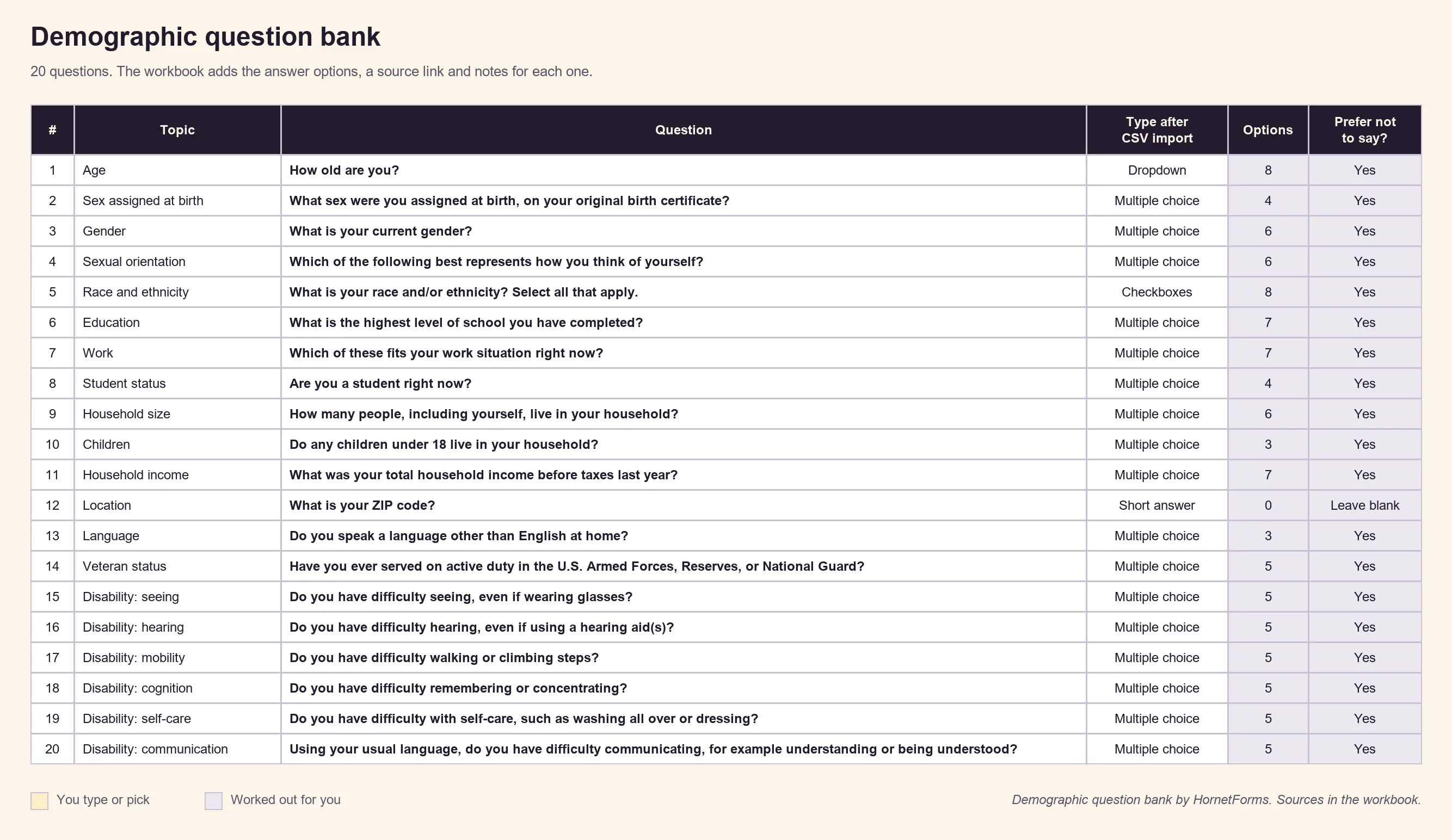
Here are the 20 demographic survey questions examples, grouped by topic. Each one ends with "Prefer not to say" (more on that in the next section). Copy only the ones that pass the test above.
Age, sex and gender#
1. How old are you? Under 18, 18 to 24, 25 to 34, 35 to 44, 45 to 54, 55 to 64, 65 or older, Prefer not to say.
Bands beat a birth date: quicker to answer and enough for most comparisons. Drop "Under 18" if only adults take part.
For sex and gender, the National Academies of Sciences, Engineering, and Medicine recommends a "two-step" measure in its 2022 report Measuring Sex, Gender Identity, and Sexual Orientation. It asks two questions, because "Asking respondents to separately identify their sex and their gender ... improves overall measurement quality" (National Academies, Measuring Sex, Gender Identity, and Sexual Orientation, 2022, Summary, accessed 28 October 2026).
2. What sex were you assigned at birth, on your original birth certificate? Female, Male, Don't know, Prefer not to say.
3. What is your current gender? Female, Male, Transgender, I use a different term, Don't know, Prefer not to say.
4. Which of the following best represents how you think of yourself? Lesbian or gay; Straight, that is, not gay or lesbian; Bisexual; I use a different term; Don't know; Prefer not to say.
The report's own versions add a free-text box after "I use a different term", and a Two-Spirit option for American Indian and Alaska Native respondents. Its last option reads "(Prefer not to answer)". The report pairs questions 2 and 3, so ask them together when gender matters to your research. Ask question 4 only when the answer changes what you'll do.
Race and ethnicity#
In March 2024, OMB revised its race and ethnicity standard, known as SPD 15. It now asks for one combined question instead of two, and adds a seventh category, Middle Eastern or North African. The notice lists "seven minimum categories": "American Indian or Alaska Native, Asian, Black or African American, Hispanic or Latino, Middle Eastern or North African, Native Hawaiian or Pacific Islander, and White" (OMB, Revisions to Statistical Policy Directive No. 15, Federal Register, 29 March 2024, accessed 28 October 2026).
5. What is your race and/or ethnicity? Select all that apply. American Indian or Alaska Native, Asian, Black or African American, Hispanic or Latino, Middle Eastern or North African, Native Hawaiian or Pacific Islander, White, Prefer not to say.
That instruction line is OMB's own: "When collecting only the minimum categories, the question instructions should read 'What is your race and/or ethnicity? Select all that apply.'" Use checkboxes, not a single choice, so people can pick more than one. Federal agencies also collect detailed groups (like Chinese or Mexican) under each category. A small survey can usually stick to the seven.
Education, work and student status#
6. What is the highest level of school you have completed? Less than a high school diploma, High school diploma or GED, Some college credit but no degree, Associate degree, Bachelor's degree, Graduate or professional degree, Prefer not to say.
This is a shorter version of the American Community Survey (ACS) question "What is the highest grade of school or degree this person has COMPLETED?" (US Census Bureau, American Community Survey 2025 questionnaire, accessed 28 October 2026).
7. Which of these fits your work situation right now? Working full time, Working part time, Self-employed, Not working and looking for work, Not working and not looking for work, Retired, Prefer not to say.
8. Are you a student right now? Yes (full time), Yes (part time), No, Prefer not to say.
Demographic survey questions for students usually go one step further. Add year of study, field of study and whether a parent or guardian finished a four-year degree. That last one tells you who's a first-generation student.
Household and income#
9. How many people, including yourself, live in your household? 1, 2, 3, 4, 5 or more, Prefer not to say.
It's adapted from the ACS opening question: "How many people, including yourself, live or stay at this address?"
10. Do any children under 18 live in your household? Yes, No, Prefer not to say.
11. What was your total household income before taxes last year? Under $25,000, $25,000 to $49,999, $50,000 to $74,999, $75,000 to $99,999, $100,000 to $149,999, $150,000 or more, Prefer not to say.
Never ask for an exact income. Ranges get more answers, and nobody has to dig out a tax form. Check that your ranges don't overlap ("$25,000 to $50,000" and "$50,000 to $75,000" both claim $50,000) and that they leave no gaps.
Location, language and veteran status#
12. What is your ZIP code? Short answer.
Use a text question, not a number, so ZIP codes that start with zero keep it. Here, leaving the box blank is the "prefer not to say". Outside the US, ask for a postcode, region or country.
13. Do you speak a language other than English at home? Yes, No, Prefer not to say.
This is ACS question 14a. The ACS follows a "Yes" with "What is this language?" and "How well does this person speak English?" (Very well, Well, Not well, Not at all).
14. Have you ever served on active duty in the U.S. Armed Forces, Reserves, or National Guard? Never served in the military; Only on active duty for training in the Reserves or National Guard; Now on active duty; On active duty in the past, but not now; Prefer not to say.
That's ACS question 27, with "this person" changed to "you".
Disability: the Washington Group short set#
Asking "Do you have a disability?" misses many people who have real difficulties but don't use the word. The Washington Group on Disability Statistics built six questions about everyday activities instead. Its short set "is intended for use in censuses and surveys", and "each question has four response categories" (Washington Group Short Set on Functioning, October 2022, accessed 28 October 2026).
Each of the six uses the same four answers: No difficulty, Some difficulty, A lot of difficulty, Cannot do at all. We add Prefer not to say as a fifth.
15. Do you have difficulty seeing, even if wearing glasses?
16. Do you have difficulty hearing, even if using a hearing aid(s)?
17. Do you have difficulty walking or climbing steps?
18. Do you have difficulty remembering or concentrating?
19. Do you have difficulty with self-care, such as washing all over or dressing?
20. Using your usual language, do you have difficulty communicating, for example understanding or being understood?
Ask all six, word for word, in this order. The Washington Group designed them for people aged five and over and publishes the analysis guidance on its website. If you need a lead-in, use its own: "The next questions ask about difficulties you may have doing certain activities."
Always offer "Prefer not to say"#
If you follow only one of the demographic survey questions best practices in this guide, make it this one. "Prefer not to say" gives people a way past a question without lying or quitting. Without it, someone who doesn't want to share their income either picks a random band (bad data) or closes the tab (no data). With it, you get an honest skip and the rest of their answers.
It also tells you something. If a third of people skip the income question, it feels too personal for this audience.
Good to know: OMB does not let federal agencies offer a "prefer not to respond" box on the race and ethnicity question, to keep federal data consistent. It also notes that "with very few exceptions, provision of race and ethnicity information is voluntary for respondents." If you want your numbers to line up with federal tables, leave the box off that one question and keep it optional instead.
Wording to avoid#
Most problems with demographic survey questions come from a handful of habits. Watch for these:
- Overlapping ranges. "18 to 25" and "25 to 35" leave every 25-year-old with two answers. End one band before the next starts.
- "Other" as the only way out. Writing "Other" next to someone's identity can feel dismissive. The National Academies use "I use a different term" instead.
- Old category names. If you're copying a race question from an old survey, check it against the 2024 categories. Many older forms still ask about Hispanic origin as a separate question and have no Middle Eastern or North African option.
- Two questions in one. "What is your gender and age?" can't be answered in one box. Our guide on how to write survey questions covers this and other wording traps.
- Assuming one household type. "How many children do you have?" isn't the same as "How many children live with you?"
One more: say why you're asking, in one true sentence above the section, like "These questions help us check that we're hearing from everyone we serve".
Make every demographic question optional#
Required demographic questions lose people at the finish line. Nobody should have to give up their income to press Submit.
In HornetForms, a question is optional until you switch on Required for it, so leave the demographic block alone. For the "I use a different term" answers, add a short-answer question underneath and a show rule so it appears only when someone picks that option. Our guide to conditional logic shows how. You can also use logic to show the ACS follow-up questions only after a "Yes" to the language question.
Pick the right type, too: multiple choice for one answer, a dropdown when the list runs long, checkboxes for race and ethnicity. Every question type and when to use it explains the difference, and survey vs questionnaire helps if you're unsure which one you're building.
Get the question bank and import the set#
Two free downloads come with this guide:
- Demographic question bank (Excel). All 20 demographic survey questions with answer options, question type, source link and notes. Mark the ones you keep in the yellow "Use it?" column and a counter adds them up. There's also a CSV version for Google Sheets or anything else.
- Demographic survey CSV for import. A file built for HornetForms' CSV import, which works on every plan.
On the Import a form screen in HornetForms, drop in the CSV. HornetForms reads it in your browser. The file has the 20 questions as column headings, a Response ID column the importer skips and 24 example rows, and the importer uses those rows to guess each question's type. They don't become responses. We ran the importer's own code on this file. Here's what you get:
- A form called "demographic survey" with two pages of 10 questions, all optional.
- Age as a dropdown with its eight options.
- Race and ethnicity as checkboxes with the seven OMB categories.
- ZIP code as a short-answer question.
- The other 17 questions as multiple choice, with every option in the order shown above, including "Prefer not to say".
Then take five minutes in the editor. Rename the form, add the free-text follow-ups and their show rules, add "Prefer not to say" to the race question if you want it, and delete what you don't need. Put your main questions first, so the demographic page lands at the end.
Once answers come in, the Summary tab shows the counts for each question. CSV export works on every plan, and Excel export comes with Pro and Business (see the pricing page). To compare groups, like ratings by age band, our guide on how to analyze survey data walks through a cross-tab, and survey response rate has ways to get more answers. For whole surveys to borrow from, see our questionnaire examples and feedback form questions. Our community needs assessment survey guide uses several of these questions.
Build your demographic section#
Pick the questions you'll use, copy the official wording where it exists, add "Prefer not to say", make them optional and put them last. That's most of what good demographic survey questions need. HornetForms is free forever on the Free plan, with unlimited responses within fair use, and there's more on the features page. Sign up for free and import the demographic set in a few minutes.