
On this page
You've found the one. Great interviews, a strong work sample, and the team likes them. All that's left is the reference check. That's where hiring often slows down: three voicemails, a referee who says "they were great" and nothing else, and notes nobody can read a week later.
Good reference check questions change that. They ask about real work, in the same way for every candidate, so you can compare answers instead of vibes. This guide gives you 30 questions grouped by what you need to learn, the questions to leave out, and how to choose between a call and a form. At the end there's a free reference check form, a printable call script and a scorecard that puts two references side by side.
When to check references and who to ask#
Check references at the end, for your final one or two candidates. Earlier than that, you waste busy people's time on candidates you won't hire. Later than that, after a job offer, the check can only confirm what you've already decided.
Ask for two or three referees, and say who you want:
- A recent manager. They saw the work, set the goals and handled the hard conversations. One manager reference is worth more than three friendly colleagues.
- A peer or a client. They see how the candidate works with people when no manager is watching.
- A direct report, if the role manages people. Nobody knows a manager better than their team.
Expect some referees to answer your reference check questions briefly. Some employers only confirm the job title and dates. Britain's workplace adviser Acas calls this a basic work reference: "A basic work reference is a short summary of employment" (Acas, what employers can say in a reference, last updated 1 October 2026). A short answer isn't a red flag on its own. It's often company policy.
Ask the candidate first#
Never call a referee the candidate didn't give you. Ask for their go-ahead, their referees' names and contact details, and how each person knows them. Tell them roughly when you'll reach out, so they can warn their referees. It's polite, and it gets you faster replies. If one of your own staff put the candidate forward through an employee referral program, you can ask them too, but still talk to a past manager.
If you use a background screening company to interview references for you, US law may treat that differently. The Fair Credit Reporting Act defines an investigative consumer report as one where information on a person's "character, general reputation, personal characteristics, or mode of living is obtained through personal interviews" (15 U.S.C. 1681a(e)). Reports like that come with written notice rules for the employer (15 U.S.C. 1681d). Checks you run yourself, with your own questions, are a different situation.
Good to know: this guide is general information, not legal advice. Reference rules differ by country, state and city, so check your local law or ask a qualified adviser before you change your process.
30 reference check questions to ask#
Pick the reference check questions that fit the role before your first call, then ask every referee the same core set. That's what makes the answers comparable. Swap "[candidate]" for their name.
Confirm the basics#
- How do you know [candidate], and how long did you work together?
- What was their job, and what were they responsible for?
- Did you manage them directly? If not, how often did you see their work?
- Can you confirm their job title and the dates they worked there?
- Do you know why they moved on?
How they do the work#
- What were they best at?
- Tell me about a piece of work they were proud of. What was their part in it?
- How would you describe the quality of their work?
- How did they handle deadlines and busy weeks?
- Tell me about a time they made a mistake. What did they do next?
- How much direction did they need to do their best work?
- What would you have liked them to do more of?
Working with others#
- How did they get on with the rest of the team?
- Tell me about a disagreement they had at work. How did they handle it?
- How did they take feedback?
- How did they deal with customers, clients or other teams?
- If they managed people: how did their team feel about working for them?
- What kind of people did they work best with?
Fit for this role#
- This job involves [two or three main duties]. How well do you think they would do?
- What kind of manager gets the best out of them?
- What kind of workplace suits them best?
- Where do they still have room to grow?
- How did they grow while you worked together?
- If you were their new manager, what would you want to know on day one?
Rehire and close#
- Would you hire them or work with them again? Why?
- On a scale of 1 to 10, how would you rate their work overall? What would make it a 10?
- Is there anything that would stop you recommending them for this job?
- Is there anything I haven't asked that you think I should know?
- Is there someone else who worked closely with them I could talk to? (Only call them if the candidate agrees.)
- Can I get back to you if I have a follow-up question?
Question 25 does the most work. Listen for the pause before the answer as much as the answer itself. "Yes, in a heartbeat" and "Yes, for the right role" are two very different references. Question 24 is a nice bonus: the answer often ends up in your new hire onboarding process.
Questions to leave out#
Good reference check questions ask about the work, not the person's private life. In the US, the Equal Employment Opportunity Commission says "Employers are explicitly prohibited from making pre-offer inquiries about disability" (EEOC, prohibited employment policies and practices, accessed 28 October 2026). The same page says questions about race, sex, national origin, age and religion are irrelevant to whether someone is qualified. Asking a referee doesn't make these questions safe. So leave out:
- Age, health, disability or sick days
- Pregnancy, children or family plans
- Religion, race, national origin or marital status
- Their life and opinions outside work
- Past salary. California says an employer "cannot, orally or in writing, personally or through an agent, seek salary history information" about an applicant (California Labor Commissioner, Equal Pay Act FAQ, citing Labor Code 432.3, accessed 28 October 2026). Asking a former employer is still you seeking it, so leave it out of reference checks too. Other states and cities have similar rules.
Referees worry about saying the wrong thing too, which is why some stay vague. Acas says that if an employer gives a reference "it must be accurate and fair". In the US, some states protect employers who answer reference requests. Take Florida. An employer who shares information when a prospective employer asks is "immune from civil liability", unless the information was knowingly false or violated a civil right (Florida Statutes 768.095). Rules vary a lot by state, so treat this as one example, not a promise.
Phone call or form#
You can ask your reference check questions on a call or in a form. Both work. They're good at different things.
| Compare | Phone call | Reference check form |
|---|---|---|
| Best for | Tone, hesitation and follow-up questions | Busy referees, written answers and comparing candidates |
| Referee's time | A booked 15 minutes, often after phone tag | A few minutes, whenever suits them |
| What you keep | Your notes | Their own words, in the same fields every time |
| Watch out for | Leading questions and notes nobody can read later | Short answers with no chance to ask "why?" |
Many teams do both: send the form first, then make a short call about anything unclear, or anything two referees see differently. If you call, the free call script below has all 30 questions with room for notes.
Send a form the referee can finish on a phone#
Our reference check form in HornetForms turns the core reference check questions above into one page:
- About the referee: name, email, job title and company.
- The relationship: the candidate's name, how they worked together (manager, direct report, teammate, client or other), the candidate's role and when they worked together.
- Four ratings in one grid: reliability, teamwork, communication and quality of work, each from below expectations to outstanding.
- The hire-again question: yes, with reservations or no. Pick either of the last two and a box appears asking for context.
- In their own words: strengths, where they could develop, and anything else you should know.
The rating grid is a matrix question, one of HornetForms' 20+ question types, and the follow-up box is a show rule from conditional logic. Both work on every plan.
Referees open the link on a phone or computer and answer without an account or a sign-in. That one detail gets more references back: nobody wants to create an account to help a former colleague. If you're comparing HornetForms with Google Forms, that's one difference worth a look. Two more touches help:
- Fill in the candidate's name for them. Give the Candidate's name question a prefill parameter in the editor, then send each referee a link with the name already in it.
- Say thanks automatically. The form asks for the referee's email, so you can send them a confirmation email with your own wording, on every plan.
Turn on email notifications and each reference lands in your inbox. You can also download any response as a PDF for the hiring file. Both work on every plan.
Three ways to use it:
- Open it in HornetForms. The template page at
forms.hornetforms.com/templates/reference-checkhas a Use this template button that takes you through sign-up and opens your own copy. - Print it. Download the PDF, US Letter, the PDF, A4 or the Word (DOCX) version, and read it out on a call if you prefer.
- Call with the script. The reference call script (PDF, US Letter) has an opening, all 30 questions with space for notes, the same four ratings as the form and a close. It also comes as an A4 PDF and a Word file.
Compare references fairly#
Two referees, two very different stories. It happens more than you'd think. The free reference scorecard (Excel) helps you see it clearly.
Export your form responses as a CSV and paste them into the Form responses tab. There's also a CSV with just the column headers if you want to check the layout first. Type any phone references into the Phone references tab, using the same four ratings. The sheet then:
- Scores each reference from 1 (below expectations) to 4 (outstanding) on all four ratings, with an average.
- Flags what needs a look: a "no" or "with reservations" on hiring again, any rating below expectations, and a referee who wasn't the candidate's manager.
- Puts two references side by side for the candidate you pick, and marks any rating where they differ by two or more steps.
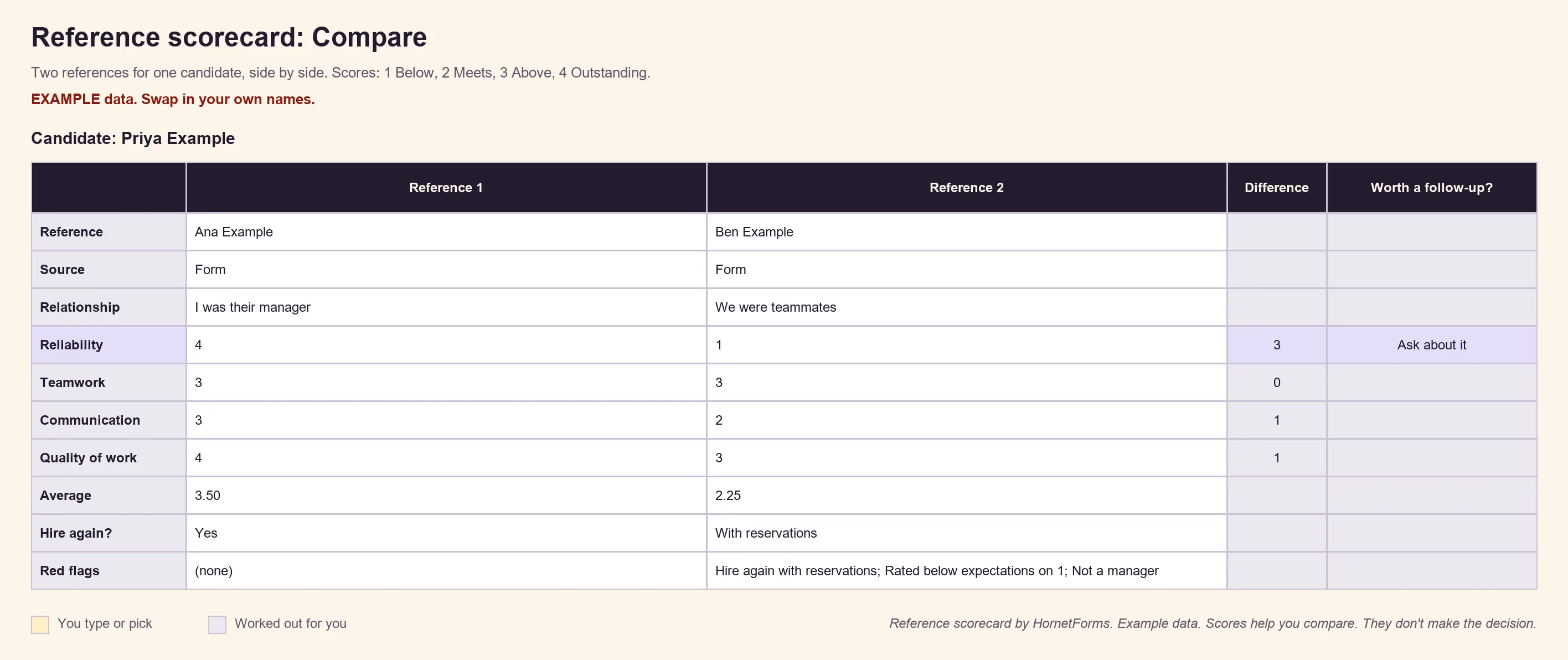
Example data only. Swap in your own names.
A big gap isn't a verdict. It's your cue for a follow-up call: "Your colleague rated their reliability highly. Can you tell me more about what you saw?" Scores help you compare. People still make the decision, and they make better ones when every candidate gets the same reference check questions. The same goes for interviews, and our interview evaluation form gives your panel one scorecard. Once the offer is accepted, an onboarding plan template turns what the referees told you into a plan for the first months.
Run your next reference check this week#
Pick your reference check questions, send the form to your candidate's referees and keep the scorecard open for the answers. HornetForms is free forever on the Free plan, with unlimited forms and responses, and there's more on the features page. Still at the hiring stage? Start with our job application form template. Sign up for free and send your first reference check form today.