
On this page
Someone on your team says, "My old colleague would be perfect for that job." Great. Then the CV turns up in a chat message, nobody writes down who referred whom, and three months later the referrer asks about the bonus nobody remembers promising.
An employee referral program fixes that with a few written rules: who can refer, what the reward is, when it pays out and how people hear back. This guide walks through each rule, with sourced research on what referrals do and plain examples you can copy. At the end there's a free policy template, a referral form and a tracker that works out when each reward is due.
Why an employee referral program works#
Your team already knows good people. A referral program gives them an easy, fair way to bring those people to you, and a reason to bother.
The case for it is well documented. SHRM, the US professional body for HR, put it this way: "Employee referral programs have proved to lower overall recruiting costs and improve the recruiting function's return on investment because referred individuals typically get up to speed faster, need less onboarding, are more satisfied in their roles and stay longer at the company" (SHRM, how to get more people to use your employee referral program, 7 November 2017, accessed 28 October 2026). The same article adds a warning: "while many employers know the value of employee referral programs, they don't always run the programs well."
A field experiment found a benefit you might not expect. Researchers rolled out referral programs at random across the stores of a grocery chain. They found that "the overall effect of having an ERP is substantial, reducing attrition by 15% and significantly decreasing labor costs." Most of that came not from the referred hires but from everyone else: "non-referrals stay longer in treated than in control stores." The authors' best explanation is that "workers value being involved in hiring" (Friebel, Heinz, Hoffman and Zubanov, NBER working paper 25920, revised August 2022, accessed 28 October 2026).
That's one study in one industry, so don't promise your board a 15% drop. But it's a good reminder that a referral program is also a way to say "we trust your judgment" to the people you already have.
Who can refer and who cannot#
Start with the simple version: everyone on your payroll can refer. Then decide who can refer but doesn't get a reward. Common exclusions are:
- The hiring manager for roles they hire for. Hiring good people is already their job.
- Recruiters and HR, for the same reason.
- Senior leaders, if your company prefers it that way.
- Contractors and agency staff, unless you agree otherwise in writing.
Then set a few rules about who counts as a new referral:
- Not someone who already works for you, as an employee or a contractor.
- Not someone who left recently. Pick a window, for example six months, so nobody refers back a person who quit last week.
- Not someone already in your process. If the candidate applied in the last six months, the referral doesn't count for a reward.
- First referral wins. If two people refer the same candidate, the earliest referral counts. A form with a timestamp settles this without an argument.
Most important of all: ask people to check with the candidate first. Nobody enjoys a recruiter calling out of the blue because a friend passed on their number.
Rewards: cash, time off or a gift#
Not every employee referral program pays cash. In the same SHRM article, one referral program expert said "about 60 percent of organizations with referral programs pay out bonuses for making referrals". The rest rely on thanks and recognition. You can mix and match:
| Reward | Example | Good to know |
|---|---|---|
| Cash bonus | A set amount per hire, higher for hard-to-fill roles | Goes through payroll and is usually taxed like pay |
| Time off | One extra day off per hire | Check how it fits your leave policy |
| A gift | A voucher, dinner for two or a donation to a charity they pick | Gift cards can be taxable too (see below) |
| Recognition | A thank-you from the founder at the all-hands | Free, and people remember it |
The amounts in this guide and in the downloads are examples only. Swap in your own.
A simple way to set amounts is by role group. For example, $250 for entry-level roles, $500 for experienced roles and $1,000 for the two or three roles you struggle to fill. Write the table into your policy so nobody has to ask.
Bigger isn't always better. The grocery-chain study found that "larger referral bonuses increase referral quantity but decrease quality". A huge bonus can turn your team into recruiters who refer anyone with a pulse. Pick an amount that says thank you, not one that changes behavior.
Taxes. In the US, the IRS lists bonuses among "supplemental wages", next to commissions and overtime (IRS Publication 15, accessed 28 October 2026). Gift cards don't escape it either: the IRS says "Gift certificates that are redeemable for general merchandise or have a cash equivalent value are not de minimis benefits and are taxable" (IRS, de minimis fringe benefits, accessed 28 October 2026). So run rewards through payroll and tell people that a $500 bonus may arrive as less after tax.
Good to know: this guide is general information, not legal or tax advice. Rules on bonuses, pay and fair hiring differ by country, state and city, so check local law and ask your payroll provider before you launch.
When the reward pays out#
Most programs wait until the new hire has stayed a while. SHRM reported that "Many companies pay part of the referral bonus on the referral's hire date and the remainder after a probationary period, often three or six months." Not everyone agrees. One expert in the same article argued that, outside high-turnover jobs, "paying the bonus in the first paycheck after a referral starts work sends the right message that your employees' efforts are valued."
Whichever you pick, write down four things:
- The waiting period. For example, 90 days after the start date.
- Who must still be there. Usually both the referrer and the new hire, on the day the reward falls due.
- How it's paid. In one go, or split between the start date and the end of the waiting period.
- When it lands. For example, in the next payroll run after the due date.
Then pay on time. A referral bonus that arrives two months late, after three reminder emails, undoes all the goodwill the program was meant to build. The free tracker below works out every due date for you, so a reward never slips through.
The referral process, step by step#
A good employee referral program fits on one page. Here's a process that works for small teams:
- The employee asks the candidate. "Would you like me to refer you?" A yes means you can reach out.
- The employee fills in a referral form. Name, contact details, the role, how they know them, why they'd be great, and a CV if they have one. One form, not a chat message.
- HR or the hiring manager looks within a set time, for example five working days.
- The candidate goes through the normal process. Same interview steps, same criteria as everyone else. A referral gets someone a fair look, not a free pass.
- The referrer hears how it went. At each stage, and at the end.
- The reward pays out when the waiting period ends.
Step 4 matters for fairness. Referrals tend to bring in people like the ones you already have. Keep advertising every role in the usual places, and score referred and non-referred candidates the same way. If you also collect applications, our job application form template keeps everyone on the same questions.
Tell people what happened to their referral#
This is where most referral programs go quiet, and it's the easiest part to fix. A referrer who never hears back won't refer again.
Promise a few updates and keep them:
- Within a few days: "Thanks, we've got it. We'll be in touch with [candidate] this week."
- At each new stage: "They're interviewing with the team on Thursday."
- At the end: "We offered them the job, and they start on 1 March" or "We went with someone else this time. Thanks for thinking of us."
Share the stage and the outcome, but not interview feedback or the reasons behind a decision. Those belong to the candidate. Write that into your policy, so referrers know what to expect and don't feel shut out.
The tracker has a column for the last time you updated each referrer. If a referral sits for longer than your own limit (14 days in the example), it flags it as Update due.
Collect referrals with one form#
The employee referral form in HornetForms puts the whole referral on one page, 12 questions in all:
- About the referrer: their name and team.
- About the candidate: name, email, LinkedIn or portfolio, and the role (a dropdown you edit to match your open jobs).
- The context: how they know each other and why they'd be great here.
- Consent: "Have they agreed to be referred?" Pick "No, please wait before contacting them" and a question appears asking when you can get in touch.
- Credit: "May we mention that you referred them?" Pick "Please keep my name out of it" and a short note confirms you'll reach out without naming them.
- Their CV: an optional file upload for a PDF or Word document, up to 10 MB on the Free plan.
The two follow-ups use conditional logic, and the CV question is one of the 20+ question types. Both work on every plan.
Each referral can go where your team already works, on every plan:
- An email to you for each new referral, once you turn it on in the form's notification settings.
- A Slack message in your hiring channel, so the hiring manager sees it the same day.
- A Google Sheets row per referral, which makes a handy starting list for the tracker below.
Our guide to where your form responses can go shows how to set each one up. One thing to plan for: everyone you add to your HornetForms workspace can read every response in it, including referrals. Add only the people who should see them. HornetForms has no response caps on any plan, within fair use, so a busy hiring month never hits a response limit. If you're weighing it up against other tools, here's how Google Forms and HornetForms compare.
Three ways to use it:
- Open it in HornetForms. The template page at
forms.hornetforms.com/templates/employee-referralhas a Use this template button that takes you through sign-up and opens your own copy. - Print it. Download the PDF, US Letter, the PDF, A4 or the Word (DOCX) version for a notice board or a break room.
- Make it yours. Change the roles, add a question about which office they'd work in, or ask for a phone number instead of an email.
Free employee referral program policy and tracker#
The policy template. The free referral program policy (Word) covers everything in this guide on two pages: who can refer, who you can refer, how to refer, what happens next, a rewards table, when the reward pays out, fair hiring, and changes. Every company detail, amount and number sits in [brackets] for you to fill in. It also comes as a PDF, US Letter and a PDF, A4. It's a starting point, not legal advice: check local law before you publish it.
The tracker. The free referral tracker (Excel) keeps one row per referral: referrer, candidate, role, stage, start date and reward. When a referral is hired, type the start date and the sheet works out the reward due date from your own waiting period (90 days in the example). Each row then shows a reward status, such as In process, Waiting, Due now, Paid or Not payable. A second status flags referrers who are due an update. The Summary tab counts referrals by stage, adds up rewards by status and shows your hire rate. Prefer another tool? The tracker as a CSV has the same columns and the example rows.
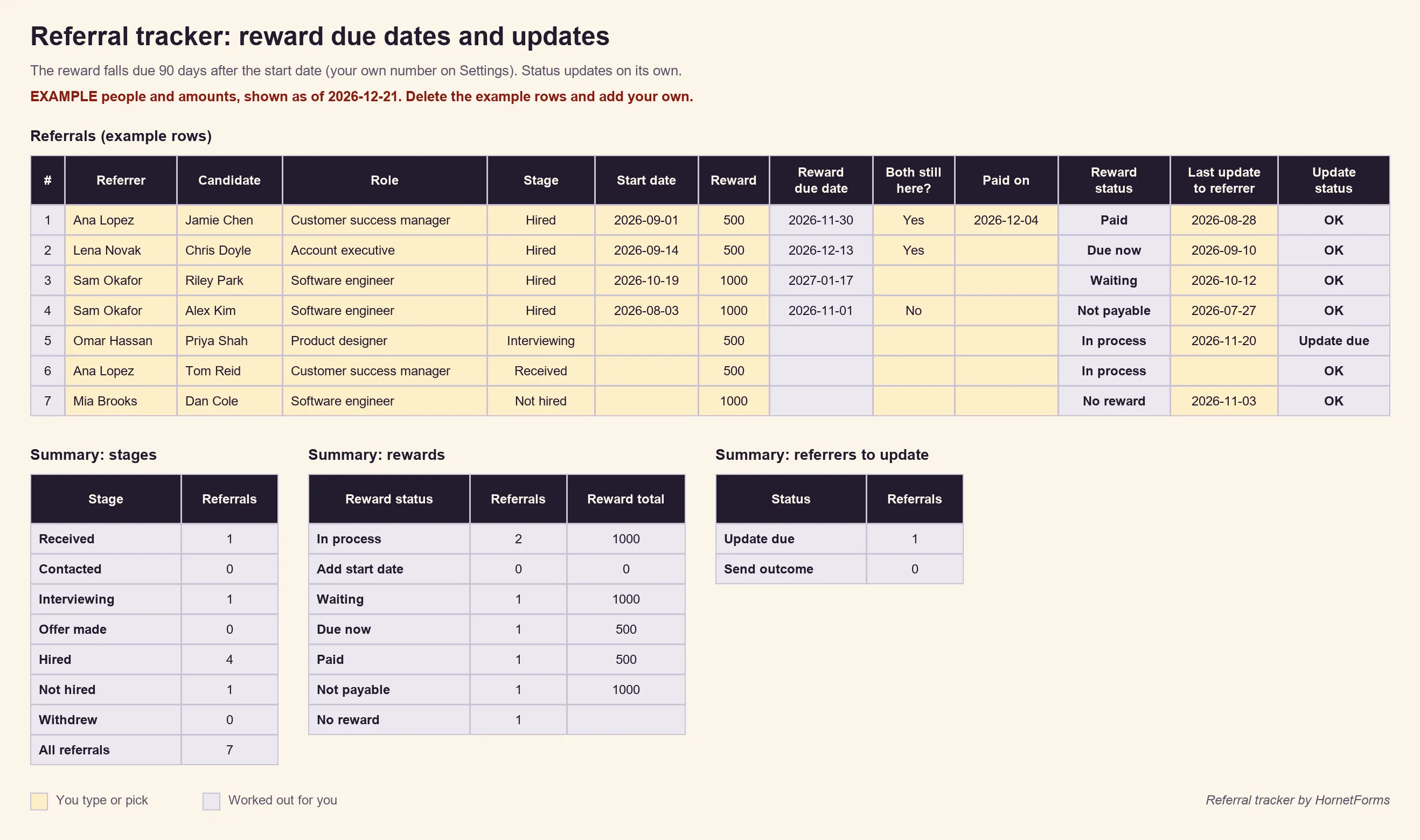
Example people and amounts only. Swap in your own.
Launch your referral program this month#
Fill in the policy, share the referral form link in your team chat and open the tracker. That's a complete employee referral program, and it takes an afternoon. HornetForms is free forever on the Free plan, with unlimited forms and unlimited responses within fair use, and the features page has the wider tour. Sign up for free and send your team the referral form before your next job goes live.